
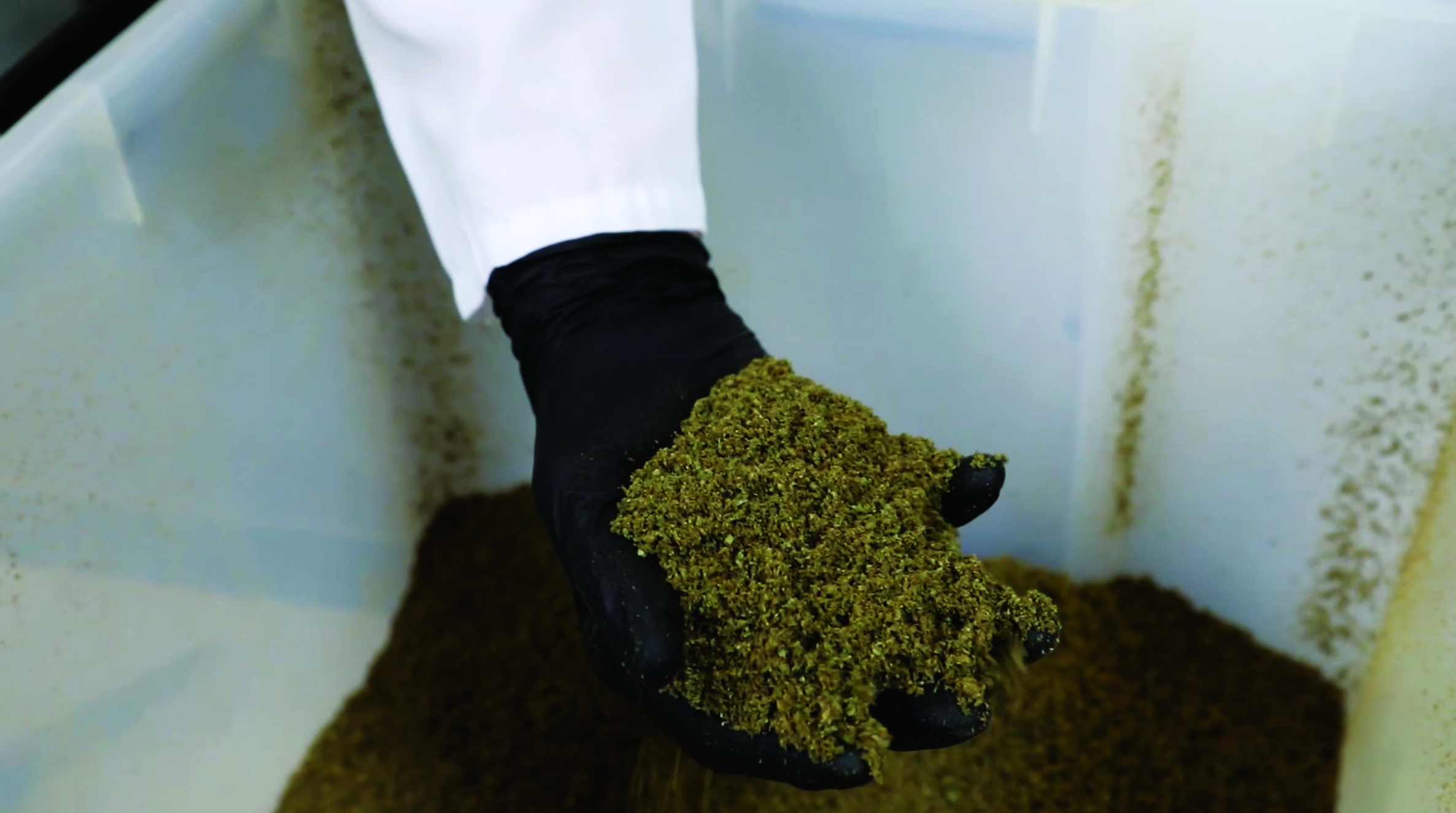
Extraction efficiency starts before the solvent ever reaches the plant material.
For cannabis, hemp, and other botanical processing applications, preparation of the biomass can have a significant effect on extraction consistency, material handling, and downstream performance. One of the most important preparation steps is size reduction.
Grinding plant material increases the available surface area and helps create more consistent conditions for extraction. But effective extraction preparation isn’t simply about making the material as small as possible.
The goal is a controlled, repeatable particle size that matches the extraction process.
What Is Extraction Prep?
Extraction preparation refers to the steps taken to condition botanical material before it enters an extraction process.
Depending on the material and extraction method, preparation may include:
- Drying or moisture conditioning
- Removal of unwanted material
- Size reduction
- Particle-size classification
- Material handling and conveying
- Blending or batch preparation
Among these steps, milling plays an especially important role because particle size can influence surface area, solvent penetration, material flow, and extraction consistency.
For commercial processors, repeatability is critical. If the material entering extraction varies significantly from batch to batch, the extraction process can also become less predictable.
Why Does Particle Size Matter for Extraction?
Grinding changes the physical characteristics of botanical material.
As material is reduced in size, its surface area increases. This can provide greater contact between the plant material and the extraction medium.
However, smaller is not automatically better.
If material is too coarse, there may not be enough exposed surface area for efficient extraction.
If material is excessively fine, it can create its own problems, including increased fines, filtration challenges, compaction or undesirable material carryover.
The objective is to find the particle-size range that provides the best balance for the specific extraction process.
Consistency Matters as Much as Size
A batch with a narrow, consistent particle-size distribution is generally easier to process predictably than a batch containing a wide mixture of coarse particles and fines.
Consistent milling can help processors achieve more repeatable:
- Solvent contact
- Material flow
- Extraction cycles
- Batch performance
- Downstream filtration
- Overall processing conditions
This is why extraction preparation should be viewed as a precision process, rather than simply a grinding step.
Extraction Method Should Influence the Grind
There is no universal particle size that is appropriate for every extraction application.
The optimal preparation depends on the extraction method, plant material, equipment and desired process performance.
Ethanol Extraction
Ethanol extraction preparation generally requires sufficient surface area for solvent contact without unnecessarily producing excessive fines.
A controlled, consistent grind can help promote repeatable solvent penetration and material handling.
The appropriate screen size should be determined based on the specific biomass and extraction process rather than assuming that a finer grind will automatically improve yield.
Supercritical CO₂ Extraction
CO₂ extraction systems require consistent material flow through the extraction equipment.
Particle-size variation can affect how material packs and how the extraction medium moves through the biomass. A controlled particle size can help create more predictable processing conditions from batch to batch.
Hydrocarbon Extraction
Hydrocarbon extraction can also benefit from controlled particle sizing.
The material needs to be prepared to support appropriate flow and contact without creating excessive fines or undesirable packing characteristics.
The right particle size should be established through process testing and based on the specific extraction equipment and operating conditions.
Avoid Over-Grinding
One of the most common mistakes in extraction preparation is assuming that finer material will always produce better extraction.
Not necessarily.
Over-grinding can create excessive fines and may make material more difficult to handle or separate. Depending on the extraction process, excessive fines can also contribute to filtration or flow challenges.
Instead of asking, “How fine can we grind the material?”, processors should ask: “What particle size gives us the best extraction performance?”
That distinction is important.
The ideal milling process creates enough surface area to support efficient extraction while maintaining the physical characteristics required by the downstream process.
Control Heat During Milling
Cannabis and hemp are high-value botanical materials, making temperature control an important consideration during processing.
Excessive heat generated during size reduction can potentially affect sensitive compounds in the plant material.
KannaMill equipment is designed specifically for cannabis, hemp and botanical materials, with milling configurations intended to provide consistent size reduction while managing heat generation and material buildup.
Processing conditions including feed rate, screen selection, rotor speed, material characteristics and mill configuration, can all influence the temperature of the material during milling.
For extraction processors, maintaining appropriate and repeatable conditions is more important than simply maximizing milling speed.
Manage Resin and Material Buildup
Cannabis and other botanical materials can be challenging to mill because of their combination of fibrous structure, moisture sensitivity and resin content.
Material buildup inside the mill can interfere with consistent processing and increase the frequency of cleaning and maintenance.
KannaMill uses a proprietary anti-resin hammer design intended to reduce buildup and maintain consistent milling performance when processing difficult botanical materials. Its KannaBevel hammer design is also engineered to support particle uniformity while reducing material waste and downtime associated with cleaning and maintenance.
Equipment design can therefore be an important consideration when selecting a mill for continuous extraction preparation.
Match the Mill to Your Production Scale
Extraction operations range from laboratory and R&D environments to large-scale commercial production.
The milling equipment should be appropriately sized for the operation.
Laboratory & R&D Processing
The KannaMill Lab Series is designed for laboratory testing, process development and small-batch botanical processing, with capacity up to 100 lb/hr and motor sizes up to ¾ HP.
Pilot-Scale Processing
The KannaMill Pilot Series provides higher-capacity processing for pilot-scale and process-development applications, with capacity up to 300 lb/hr and motors up to 3 HP.
Production Processing
The KannaMill Production Series is designed for higher-throughput botanical processing, with capacity up to 600 lb/hr and motor sizes from 5–10 HP or less.
High-Capacity Processing
For large-scale biomass processing, KannaMill High Capacity systems are custom engineered for the material, throughput and finished particle-size requirements of the application. Systems are available in single-stage or dual-stage configurations and start at 30 HP.
This range allows processors to select equipment around their actual production requirements rather than trying to adapt a small laboratory grinder or agricultural mill to a commercial-scale process.
Use the Right Screen Size
Screen selection is one of the primary ways to control the finished particle size from a hammer mill.
Different screen openings can produce different particle-size distributions, allowing processors to adjust the milling process around their extraction requirements.
The correct screen depends on:
- Extraction method
- Desired particle size
- Throughput requirements
- Moisture content
- Material characteristics
- Downstream handling requirements
KannaMill systems can be configured with multiple screen sizes, allowing processors to adjust particle sizing for different applications.
Rather than selecting a screen based on a generic industry recommendation, processors should evaluate the screen against their actual extraction process.
Consistency Is the Key to Repeatable Extraction
One of the biggest advantages of industrial milling over manual or improvised grinding is repeatability.
A commercial extraction process may process hundreds or thousands of pounds of material. Small variations in particle size can become significant when they are repeated across large production volumes.
A properly configured industrial mill can help standardize the preparation step by producing a more consistent particle-size distribution from batch to batch.
That consistency can help processors:
- Reduce batch-to-batch variation
- Improve material flow
- Standardize extraction preparation
- Optimize downstream processing
- Reduce manual processing
- Increase production efficiency
For processors scaling from small-batch extraction to commercial production, repeatability becomes increasingly important.
Extraction Prep Is More Than Grinding
A successful extraction process depends on more than the extraction equipment itself.
The material entering the extractor needs to have the physical characteristics required for the process to operate consistently.
That means extraction preparation should be considered as part of the overall process design.
Material → Conditioning → Size Reduction → Extraction → Filtration/Separation → Finished Product
When milling is treated as an integrated part of that process, processors can optimize particle size around the requirements of the equipment that follows.
Better Extraction Starts With Better Preparation
Extraction prep is easy to overlook because it happens before the main extraction process begins. But the physical characteristics of the material entering the extractor can influence how consistently the entire process performs.
The objective isn’t simply to grind cannabis or hemp. It is to produce consistent, controlled, extraction-ready material.
The right milling system can help processors achieve repeatable particle size, manage difficult botanical materials, maintain production efficiency and prepare biomass for the specific extraction process being used.
KannaMill provides scalable milling systems for cannabis, hemp and botanical processing, from laboratory and pilot applications through high-capacity commercial production.
Looking to improve your extraction preparation process? Talk with KannaMill about your material, extraction method and production requirements.